Black Holes: Where Even Light Cannot Escape
Black holes are some of the most mysterious objects in the universe. Their gravity is so strong that even light cannot escape. Although we cannot see them directly, scientists can find them by watching how they affect nearby stars and gas.
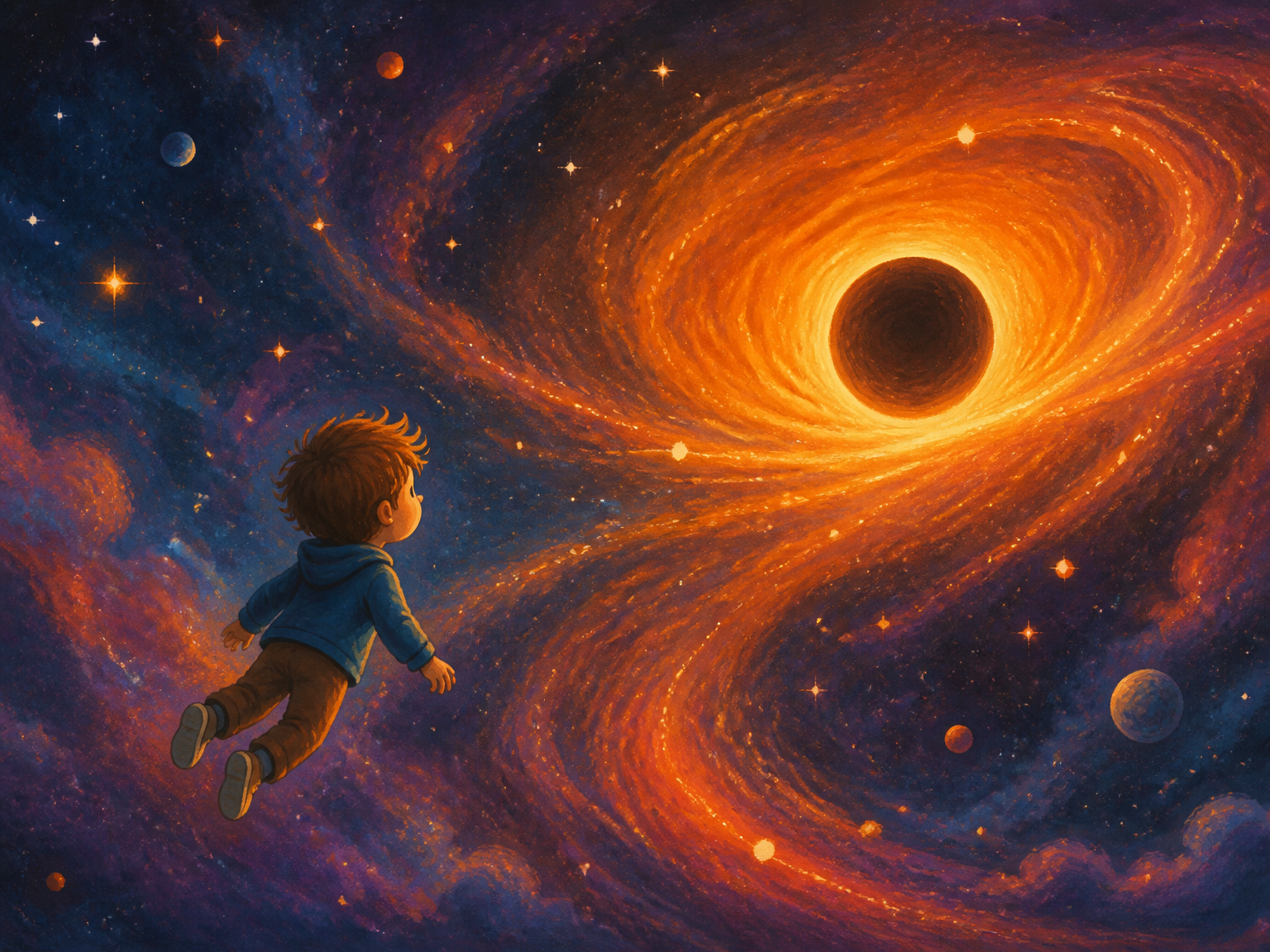
Imagine standing in the dark emptiness of space. In front of you is a round spot you cannot see. Stars and gas swirl around it like water going down a drain. The closer they get, the faster they spin. Then, they vanish without a trace. This is a black hole — the universe's strongest invisible vacuum cleaner.
A black hole is not really a hole. It is an incredibly dense object. Think of it this way: if you squeezed the whole Earth into the size of a marble, its gravity would become so strong that even light could not escape. Anything — a star, a speck of dust, even a beam of light — that crosses an invisible boundary called the event horizon can never come back out. It is like a one-way door.
How do black holes form?
Most black holes are born when a giant star dies. When a star much bigger than our Sun runs out of fuel, it explodes in a huge blast called a supernova. The star's core then collapses under its own weight, crushing itself into a tiny, super-dense point. That is the birth of a black hole.
Some black holes are enormous. They are called supermassive black holes, and they sit at the centre of most galaxies, including our own Milky Way. The black hole in the middle of the Milky Way is called Sagittarius A*. It has a mass about four million times that of the Sun. Scientists are not sure how these giants got so big. They might have grown by eating gas and stars, or by merging with other black holes.
How do scientists see something invisible?
Black holes do not give off any light, so you cannot see them with an ordinary telescope. But scientists are clever. They use two main tricks to find black holes.
First, they look at the material around a black hole. When gas and dust get pulled in, they swirl around at incredible speed, forming a flat, spinning disc called an accretion disk. The friction makes the material extremely hot, so it glows brightly in X-rays. Scientists can detect those X-rays with special telescopes.
Second, they watch how a black hole's gravity affects nearby stars. If a star orbits something heavy that is invisible, scientists can calculate how massive that hidden object is and where it is. That is how we know there is a supermassive black hole at the centre of our galaxy.
In 2019, scientists did something amazing. They used eight telescopes around the world, linked together to act like one giant Earth-sized telescope, and took the first-ever picture of a black hole! The image shows a glowing orange ring with a dark shadow in the middle. That black hole is in a galaxy called M87, 55 million light-years away from Earth.
What would happen if you fell into a black hole?
If you accidentally fell into a black hole, you would have a very strange trip. The gravity pulling on your feet would be much stronger than the gravity pulling on your head. Your body would be stretched out like a piece of spaghetti. Scientists actually call this spaghettification.
But do not worry. The nearest black hole is thousands of light-years away. Earth is perfectly safe. Black holes do not roam around sucking things up like in the movies. They only affect things that come very close.
- space
- black hole
- gravity
- astronomy
- event horizon
- science