Scientific Balloon
A scientific balloon is a giant helium-filled balloon that carries experiments to the edge of space, 30 kilometres up. It is cheaper than a rocket and perfect for studying the upper atmosphere.
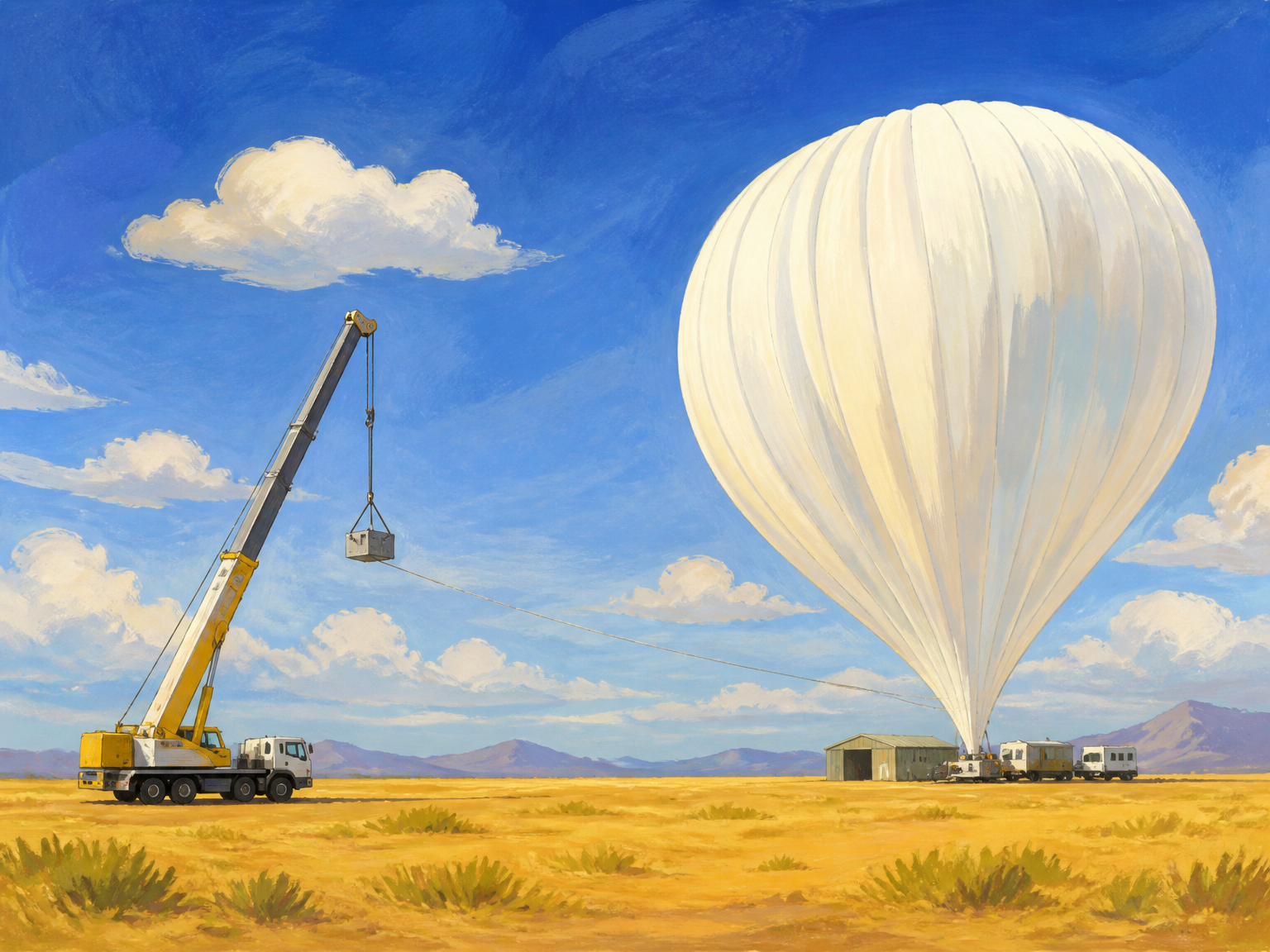
Imagine standing in a dusty desert, looking up at a balloon so huge it could swallow your whole school. It is not a toy. It is a scientific balloon, and it is about to carry a box of experiments all the way to the edge of space.
Scientific balloons are enormous envelopes made of thin, strong plastic. They are filled with a gas that is lighter than air, usually helium. When the balloon is released, it rises because the gas inside is much lighter than the air around it. The higher it goes, the thinner the air becomes, and the balloon expands until it is as wide as a football field. At its highest point, it can be more than 30 kilometres up — that is three times higher than a passenger jet flies, and well into the layer of the atmosphere called the stratosphere.
What do they carry?
These balloons do not carry people. Instead, they carry a payload — a package of instruments and experiments that scientists want to test in the near-space environment. The payload might include cameras to take pictures of Earth from above, sensors to measure the ozone layer, or telescopes to study the Sun and stars without the blurring effect of the lower atmosphere. Because the balloon stays up for hours or even days, scientists can collect data steadily, much longer than a rocket flight would allow.
How do they come back down?
When the mission is over, the balloon is commanded to release its gas. A parachute opens, and the payload floats gently back to the ground. Scientists track the payload with GPS and send a team to recover it. The balloon itself often tears apart during the descent and falls in pieces, but the payload — the valuable part — is usually reusable.
Why use a balloon instead of a rocket?
Rockets are powerful but expensive. A scientific balloon is much cheaper to build and launch. It cannot go all the way into space — it only reaches the upper atmosphere — but that is exactly where many experiments need to be. For studying the ozone layer, cosmic rays, or the faint light from distant stars, the edge of space is perfect. And because the balloon is slow and gentle, the payload does not have to survive the violent shaking of a rocket launch.
- science
- technology
- space
- atmosphere
- balloons