Globular Cluster
A globular cluster is a huge, round group of hundreds of thousands of old stars, packed tightly together by gravity. They are some of the oldest objects in the universe and act like fossils, helping astronomers learn about the early Milky Way. The brightest ones can even be seen with your own eyes on a dark night.
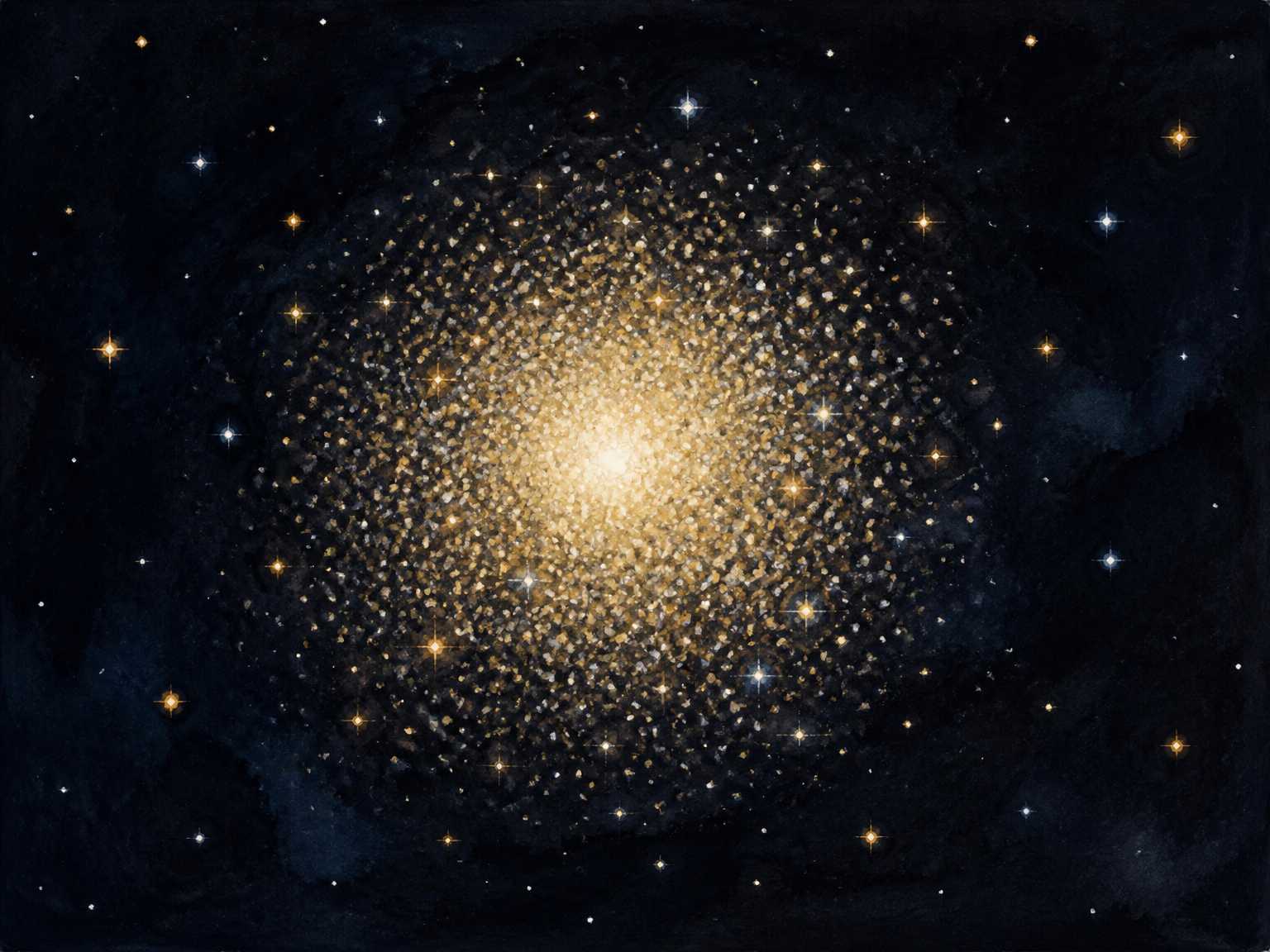
Imagine you are looking up at the night sky from a very dark place, far from any city lights. Among the thousands of twinkling stars, you might spot a small, fuzzy patch of light, like a tiny cloud. That fuzzy patch could be a globular cluster — a gigantic, ancient ball made of hundreds of thousands of stars, all packed together and held by gravity. These clusters are like time capsules, holding secrets from when our Milky Way galaxy was very young.
What is a globular cluster, exactly?
A globular cluster is a huge, round group of stars. The word "globular" comes from the Latin word *globulus*, which means "small sphere." Imagine a sphere, like a soccer ball, but instead of air, it is filled with stars. These stars are incredibly close together, especially near the center. In the core of a globular cluster, stars are packed so tightly that they are only about one light-year apart from each other. For comparison, the nearest star to our Sun, Proxima Centauri, is over four light-years away. Some globular clusters are 10 to 300 light-years across and can contain anywhere from ten thousand to several million stars. They are much older and denser than another kind of star group called an open cluster, which you might see as a loose handful of stars in the sky.
Where do you find globular clusters?
You can find globular clusters in nearly every large galaxy. In our own Milky Way, they mostly live in the galactic halo — a big, spherical region that surrounds the flat, spiral disk of the galaxy. Think of the Milky Way as a spinning dinner plate, and the globular clusters are like old marbles orbiting far above and below the plate. Astronomers have found more than 150 globular clusters in the Milky Way, and there are probably many more hidden behind dust and gas. Bigger galaxies have even more. The Andromeda galaxy, our closest large neighbor, has about 500. Some giant galaxies, like M87, have thousands of them.
Why are globular clusters so important to astronomers?
Globular clusters are some of the oldest objects in the universe. Most of their stars formed at nearly the same time, more than 10 billion years ago — that is more than twice as old as our Sun. Because they are so old, they act like fossils. By studying the stars in a globular cluster, astronomers can learn what the universe was like when it was young. For example, the stars in these clusters contain very few "heavy" elements (like iron or gold). They are made mostly of hydrogen and helium, the simplest elements created just after the Big Bang. This tells us that the stars in globular clusters were among the first to form in the galaxy. In the early 1900s, astronomer Harlow Shapley used the positions of globular clusters to figure out that our Sun is not in the center of the Milky Way. Instead, the Sun is far out in the galaxy's disk, and the center is a bright, crowded place near the constellation Sagittarius.
Can a globular cluster be seen with your own eyes?
Yes! The brightest globular cluster in the northern sky is called M13, or the Great Hercules Cluster. On a clear, dark summer night, you can spot it with your naked eye as a faint, fuzzy star in the constellation Hercules. With a pair of binoculars, it looks like a beautiful, glowing ball of cotton. Another famous one is Omega Centauri, which is so bright and big that people thought it was a single star for thousands of years. It is only visible from the southern hemisphere. Omega Centauri contains about 10 million stars and is one of the largest globular clusters known in the Milky Way.
- space
- stars
- astronomy
- Milky Way
- ancient